Your insurance company decides whether and how much to pay based on your policy and its adjuster's inspection. What you control is the record. This checklist explains what to capture for siding, trim, and gutters, and how to keep it organized.
On this page
Right after the storm: safety and the storm record
Stay away from downed power lines and do not climb onto the roof. Once it is safe, write down the date and approximate time of the storm, the direction the wind and hail came from, and how long it lasted. If you can safely do it, photograph hailstones next to a coin or ruler for scale before they melt.
The National Weather Service uses common objects to describe hail: about 0.75 inch is penny-size, 1 inch is quarter-size, 1.75 inches is golf-ball-size, and 2 inches is hen-egg-size. Hail of 1 inch or more, or wind gusts of 58 mph or more, makes a thunderstorm severe.[1][2]
Later, you can check NOAA's Storm Events Database for official reports near your address on that date.[3] It does not capture every storm in every neighborhood, but a nearby report helps connect the damage to a specific event.
Photograph every side of the house
Start with wide shots that show each full elevation, front, back, and both sides, so it is clear which wall each close-up comes from. Then work along each wall taking medium and close-up shots of anything damaged. Turn on timestamps and location on your phone camera if available, and do not edit or filter the photos.
The side that faced the storm usually takes the most damage, but check all four. Damage hidden behind shrubs, on a back gable, or on a detached garage is easy to miss and easy to forget when talking to an adjuster.
- Wide shot of each elevation, including the roofline
- Medium shot of each damaged area, showing where on the wall it is
- Close-up of each crack, hole, dent, or missing piece, with a coin or tape measure for scale
- Video walk-around of the whole house, narrating what you see
What hail and wind damage look like on siding
Hail on vinyl siding typically leaves cracks, punctures, or broken corners, often concentrated on one side of the house. Vinyl's impact resistance drops in cold weather, so damage can be more severe.[7] Hail dents aluminum siding, trim, and gutters; dents can be easier to see in low-angle morning or evening light.
Wind damage usually shows up as panels that have unlocked, flapping, or blown off entirely, often at corners, gables, and the top course under the soffit. Look also for bent or missing corner posts, lifted trim, and torn soffit panels.
- Siding: cracks, holes, chips, unlocked or missing panels
- Trim and fascia: dents in aluminum wrap, lifted or missing pieces
- Gutters and downspouts: dents, separations, pulled-away hangers
- Window screens and frames: tears and dents, which help show hail size and direction
- Soft metals such as vents and AC fins: dents that show the storm's direction
Prevent further damage, and record that too
If a panel is missing or a hole lets water into the wall, cover it temporarily with plastic sheeting or tape to stop further damage. The Ohio Department of Insurance says the reasonable cost of temporary repairs is typically reimbursed, so keep receipts and photograph the damage before and after.[4] Hold off on permanent repairs until the insurer has had the chance to inspect.
Keep any pieces of siding that blew off. They can show the color and profile of the siding for matching, and they are part of the evidence.
Keep a written log
A simple notebook or document saves trouble later. The Department of Insurance recommends keeping records of all conversations, including the date and the name of the person you spoke with, and copies of all documents.[4]
- Storm date, time, hail size, and wind direction
- List of damage by wall, with photo file names
- Temporary repairs made, with receipts
- Claim number, adjuster name, and contact details
- Every call and email: date, who, and what was said
Working with a contractor
A contractor can inspect, document damage you may have missed, and write a repair estimate for the adjuster to review. Buckeye Exteriors helps homeowners document storm damage for insurance claims. The Department of Insurance advises that you keep control of the claim yourself: do not give a contractor power of attorney, do not let them negotiate or settle the claim for you, and do not let anyone inspect when you are not home.[5]
Be cautious with anyone who promises a claim will be approved or that your insurer will pay for a full replacement before the adjuster has looked at the house. No contractor can guarantee what an insurer will decide.
Know your deductible before you file
Many Ohio policies have a separate wind and hail deductible, which may be a flat amount or a percentage of the home's insured value.[6] If the damage is small, compare the estimated repair cost to the deductible before deciding how to proceed, and ask your agent how a claim may affect your policy. For the full claim process, see how to navigate a storm damage insurance claim.
Real Buckeye projects
Work we have finished on homes like this
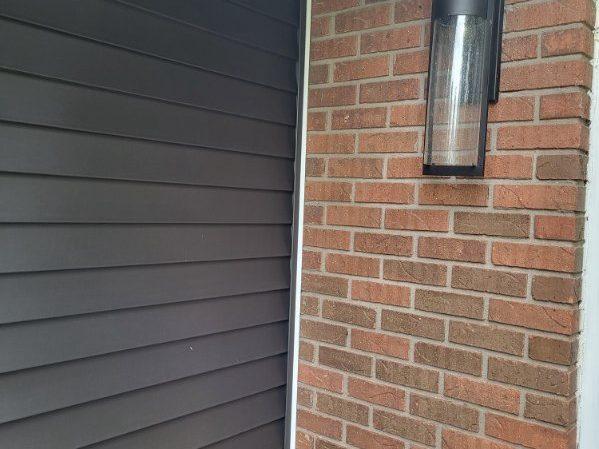
Siding, Fascia & Insurance
Storm Damage Insurance Claim
Sheffield Village
Storm-damaged siding documented for the insurer, then replaced with dark gray siding over new house wrap.
See the project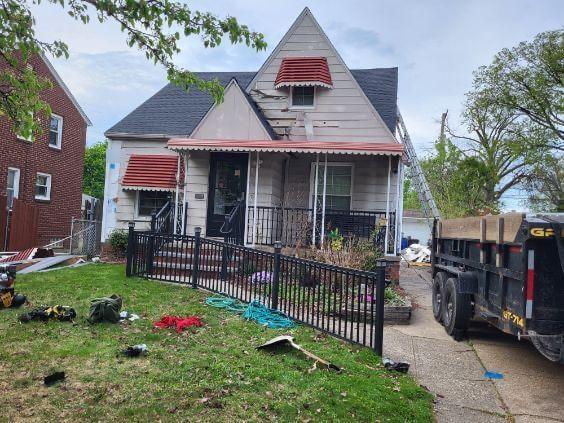

Siding & Insurance
Insurance Claim Restoration
Insurance-approved siding restoration that kept the red awnings the homeowner loved.
See the projectRelated services
Where Buckeye can help
Talk to Buckeye
Questions about your project?
Call or text to talk through siding, trim, roofing, or gutters. We are available Monday through Saturday.
Sources
- 1.Severe Weather Definitions (hail size guide), National Weather Service, Binghamton NY office. Accessed Nov 17, 2026.
- 2.Severe storms, National Oceanic and Atmospheric Administration. Accessed Nov 17, 2026.
- 3.Storm Events Database, Cuyahoga County, Ohio, 2016–2025, NOAA National Centers for Environmental Information. Accessed Nov 17, 2026.Counts are events reported to the National Weather Service, not a measure of damage to any home.
- 4.Severe Weather Toolkit, Ohio Department of Insurance. Accessed Nov 17, 2026.
- 5.Contractor Fraud, Ohio Department of Insurance. Accessed Nov 17, 2026.
- 6.Homeowners Insurance Guide, Ohio Department of Insurance. Accessed Nov 17, 2026.
- 7.Preservation Brief 8: Aluminum and Vinyl Siding on Historic Buildings, National Park Service, Technical Preservation Services. Accessed Nov 17, 2026.